
How AI companions are influencing teens to trust on those conversational bots and share private information without hesitation is increasing the chance of bot addiction with data manipulation . AI use is not just homework help or random questions anymore for some teens. It has become a place to unload. A place to ask things they don’t want to ask out loud. Sometimes, it’s just… somewhere to go when they feel off.
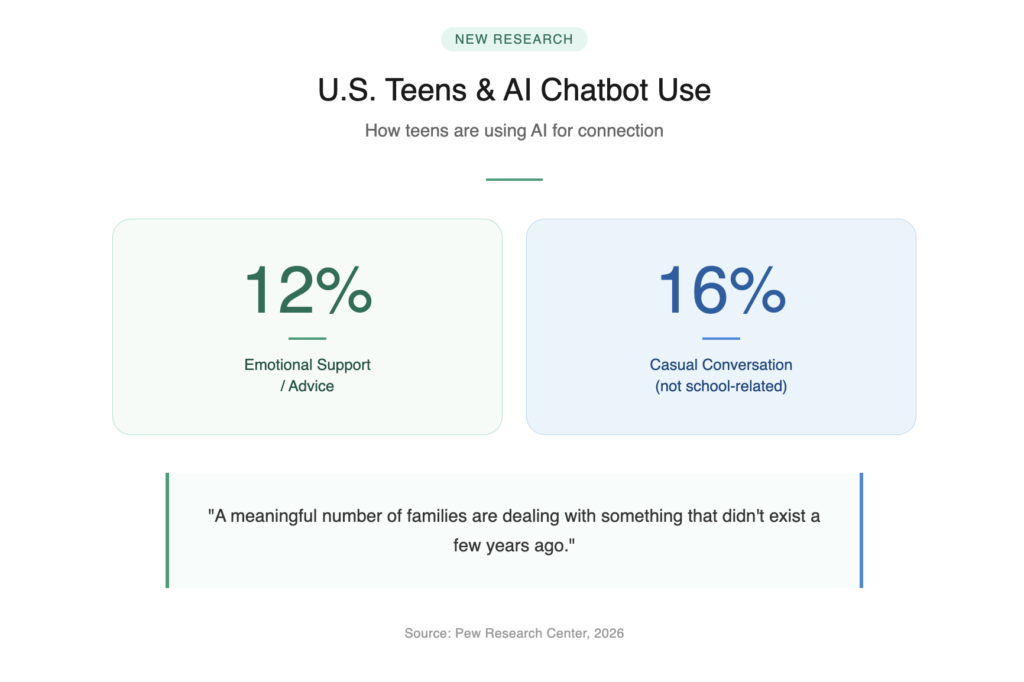
A Pew study (2026) said around 12% of teens have used AI for emotional support. That number isn’t shocking on its own. What’s different is how normal it already feels. No big moments. No announcement. Just part of the background.
That doesn’t mean something is wrong with your teen. But it does change what role this technology is starting to play in their life — and that’s worth noticing.
Where the real concerns come in
None of this is dramatic on the surface, which is part of the problem. But underneath, there are a few things going on.
Privacy isn’t always obvious to them
A teen might share things they’d never post publicly — family issues, personal thoughts, even photos . AI systems that can process and store that information.
The advice can sound better than it is
AI is very good at sounding steady and reassuring. Even when it’s wrong. That’s not a huge deal for basic questions, but it is not sensible to rely on AI advice when the topic is mental health, relationships, sex, or substance use.
A RAND report found about 1 in 8 adolescents and young adults (ages 12–21) use AI chatbots for mental health-related advice. That doesn’t automatically mean harm — but it shows these tools are already part of how many young people cope.
It can quietly become a habit
Not all at once. Just… easier. Easier than explaining things to a parent. Easier than texting a friend. And over time, that “easier” option can start replacing real conversations.
The American Psychological Association (APA) has warned that young teens need stronger guardrails. That doesn’t mean every teen-chat is dangerous but worth understanding the design.
Why this usually flies under the radar
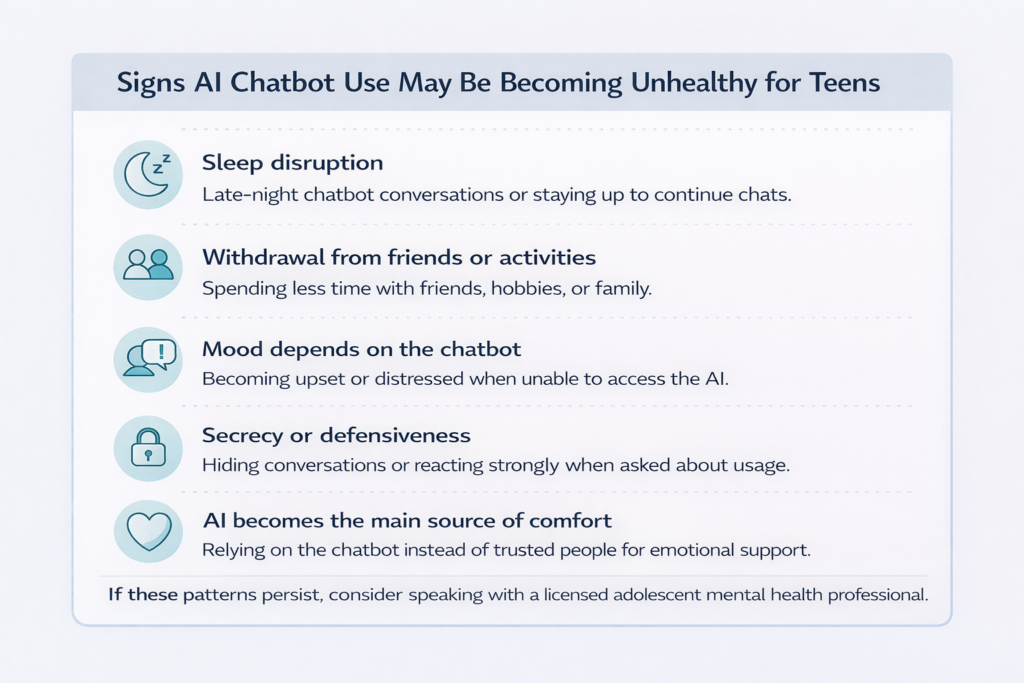
There’s rarely a big moment where you think, “okay, something’s wrong.” It’s more like small shifts like not as interested in people or things they used to enjoy
But when they start stacking up, it can point to something changing in how your teen is coping or connecting.
What actually helps (and what doesn’t)
Going in heavy usually shuts things down. A better starting point is just… asking. Not in an investigative way. Just normal curiosity:
- “What do you usually use it for?”
- “What do you like about it?”
- “Do you ever go on it more when you’re stressed?”
You’re not trying to catch anything. You’re trying to understand what it’s doing for them. From there, keep boundaries simple and realistic:
- no sharing personal details (name, school, location)
- no sending photos
- don’t treat it like expert advice
And one that matters more than all the others is that – Some conversations shouldn’t happen with AI at all. Mental health. Safety. Self-harm. Sex. Substance use. Those need real people — people who can actually step in if something’s wrong.
When it’s worth looking closer
If it starts to feel like AI is their go-to for everything, especially emotionally and that is the time to pay attention.
Same if it’s the only place they seem comfortable opening up. At that point, the concern usually isn’t the app itself. It’s that your teen might not feel like they have another place to go. And that’s the part that matters most.
Safety note: If you believe your teen is in immediate danger or at risk of self-harm, call your local emergency number. In the U.S., you can also call or text 988 (Suicide & Crisis Lifeline).
The bottom line
This isn’t really about teens using AI. It’s about what happens when AI starts to feel easier than people and more over a privacy concern of cyber activity. That’s the shift worth paying attention to — because once that line moves, it’s not always obvious right away.
You don’t need to wait for a crisis. Consider talking with a licensed adolescent mental health professional for Teen Mental Health Treatment if you’re seeing a consistent pattern like:
- worsening mood or anxiety
- big behavior shifts
- school functioning dropping
- isolation increasing
- sleep disruption becoming normal
- the AI becoming the only reliable comfort
FAQs
Is AI capable of storing what teens share?
-Yes, it is. The conversations will be processed and stored depending on the AI.
Should I be immediately concerned?
-It depends on several things, but it’s not always necessary.
What is the biggest concern?
-When it begins to become the primary means of coping and communicating.
What should I do first?
-You should begin by trying to understand why your teen is using AI.

Austin Davis, LPC-S
Founder & CEO
Originally from the Saginaw, Eagle Mountain area, Austin Davis earned a Bachelor of Science in Pastoral Ministry from Lee University in Cleveland, TN and a Master of Arts in Counseling from The Church of God Theological Seminary. He then went on to become a Licensed Professional Counselor-Supervisor in the State of Texas. Austin’s professional history includes both local church ministry and clinical counseling. At a young age, he began serving youth at the local church in various capacities which led to clinical training and education. Austin gained a vast knowledge of mental health disorders while working in state and public mental health hospitals. This is where he was exposed to almost every type of diagnosis and carries this experience into the daily treatment.
Austin’s longtime passion is Clearfork Academy, a christ-centered residential facility focused on mental health and substance abuse. He finds joy and fulfillment working with “difficult” clients that challenge his heart and clinical skill set. It is his hope and desire that each resident that passes through Clearfork Academy will be one step closer to their created design. Austin’s greatest pleasures in life are being a husband to his wife, and a father to his growing children. He serves at his local church by playing guitar, speaking and helping with tech arts. Austin also enjoys being physically active, reading, woodworking, and music.